How AI Is Changing the Economy by Changing the Rules of Economics
Is AI changing economics, not just the economy?
How AI is reshaping both the real economy and the way economists think—with real‑world examples in jobs, productivity, and policy.
Why this question is suddenly urgent
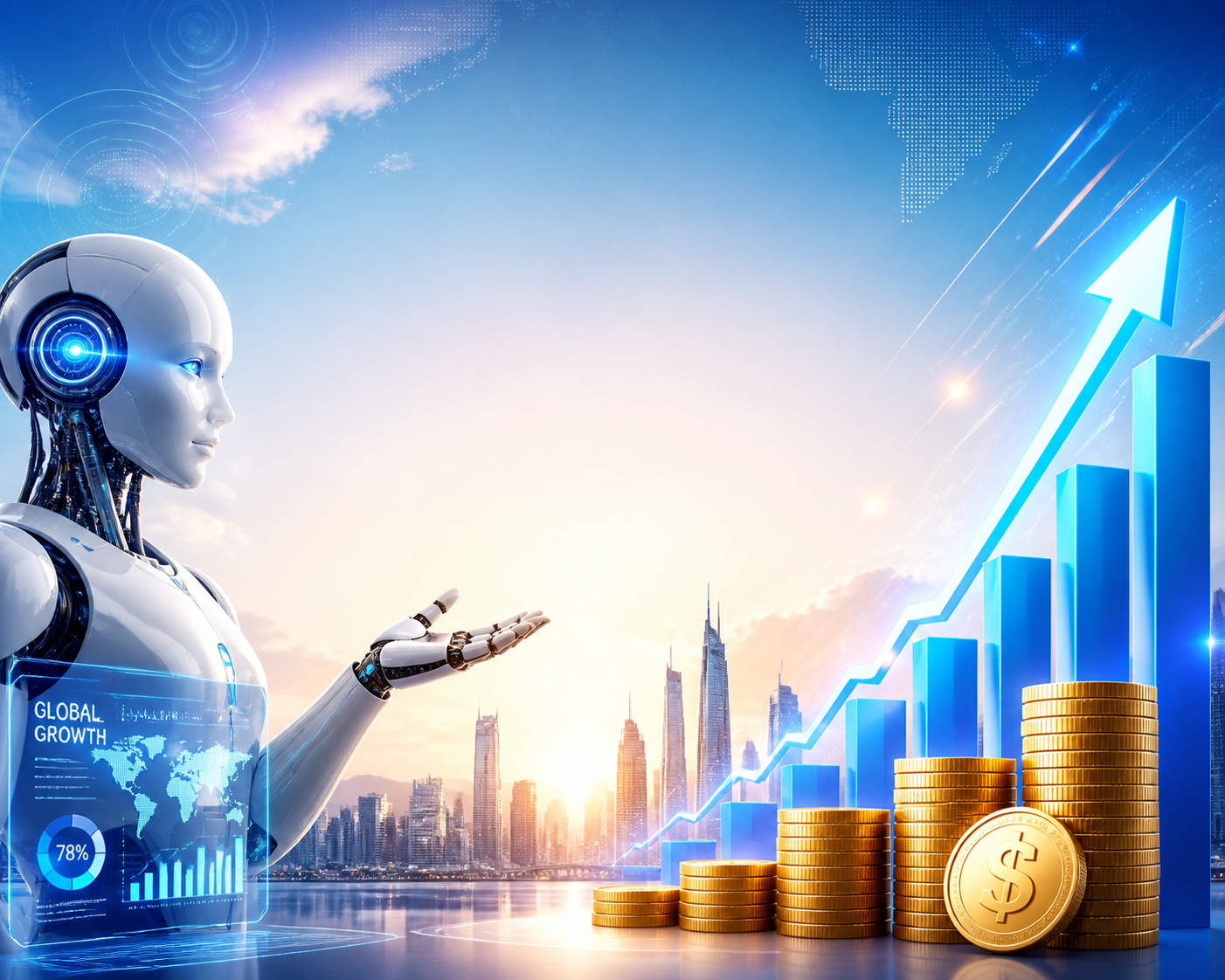
AI used to be a topic for sci‑fi movies. Now, it’s part of daily life in finance, tech, and even classrooms. The question is shifting from “What can AI do?” to something bigger: Is AI changing economics, not just the economy?
Organizations like the CBO, IMF, OECD, MIT, and Stanford now treat AI as a force that could change how we model growth, jobs, wages, and macro policy. Some economists even talk about a new sub‑field: AI economics.
In this post, we’ll look at short, vivid examples from productivity experiments, financial work, and classroom teaching that show how AI is changing both the economy and the way economists study it.
Real‑world productivity: call‑center AI
One of the clearest proofs that AI moves productivity comes from a study of customer‑support agents. When frontline workers used AI assistants, productivity rose by about 34% for low‑skill and medium‑skill employees.
Similar patterns now appear in banking, consulting, and public services, where AI shortens time spent on routine tasks and lets workers focus on analysis, judgment, and client relationships.
AI in finance and research
In finance and economic research, AI tools can handle data cleaning, regressions, and basic forecasting explanations. A junior economist can now upload a dataset, ask AI to run a model, and get formatted output plus a short explanation in seconds.
Entry‑level roles in economics and finance remain “AI‑exposed,” but new hybrid roles—AI‑assisted analysts, AI‑validators, and AI‑prompt engineers—are emerging at the same time.
AI and GDP: what the numbers suggest
Macro models and forecasts now try to quantify AI’s effect on overall growth.
- Some estimates put AI‑driven productivity gains at about 1–2% of global GDP over the next decade, with higher scenarios reaching 7%.
- One detailed study projects that generative AI alone could raise U.S. labor productivity by 1.5–1.8% annually by 2035.
- Even conservative simulations still see a 1–4% boost in GDP levels over the coming decades.
These aren’t just theory: AI‑related investments and productivity gains are already showing up in data from the U.S. and other advanced economies.
Four ways AI is changing economics
1) Productivity: AI as a cognitive copilot
AI is changing how economists think about productivity. In the past, it came from better machines or logistics. Now, AI tools for code, reports, and data analysis directly lift output per worker.
2) Jobs and wages: reshuffling, not just destroying
AI doesn’t just “kill” jobs; it reshuffles them. Low‑skill, routine tasks are more exposed, while AI‑savvy roles often see higher demand and pay.
3) Corporate strategy and concentration
AI can also concentrate economic power. A 2026 study found that about three‑quarters of AI’s economic gains go to a small group of large tech‑heavy firms—a classic “winner‑takes‑most” pattern.
4) Policy and safety nets
If AI lifts productivity but reshuffles jobs, governments must rethink taxes, welfare, and retraining.
How AI is changing economists themselves
AI isn’t only changing the economy; it’s changing how economists work and teach.
- Graduate students use AI for drafting code, debugging models, and summarizing papers—cutting hours of manual work.
- Some research combines human‑designed theory with AI‑generated data processing and visualization.
- Classrooms now include AI‑assisted exercises, where students learn to “talk to AI” like a tool.
This is why many economists now talk about sub‑fields like AI‑macro, AI‑labor, and AI‑policy: AI is both their subject and their tool.
So, is AI changing economics, not just the economy?
AI has three main effects:
- Changes the real economy: growth, jobs, wages, and inequality;
- Changes the tools: data, code, and modeling become faster and more experimental;
- Changes the theories: economists now ask new questions about AI‑driven growth, AI concentration, and AI‑skill premiums.
In short, yes—AI is changing economics, not just the economy. This is a snapshot of how both the real‑world economy and the discipline of economics are being reshaped by AI.
Comments
Post a Comment